
CytoTRACE:细胞轨迹重建和推理#
CytoTRACE是一种用于从单细胞转录组学数据推断细胞分化状态的计算方法。它不需要先前的细胞轨迹信息,而是仅从基因表达数据推断细胞状态的有序排序。
import omicverse as ovov.plot_set()
____            _     _    __
  / __ \____ ___  (_)___| |  / /__  _____________
 / / / / __ `__ \/ / ___/ | / / _ \/ ___/ ___/ _ \
/ /_/ / / / / / / / /__ | |/ /  __/ /  (__  )  __/
\____/_/ /_/ /_/_/\___/ |___/\___/_/  /____/\___/

Version: 1.6.3, Tutorials: https://omicverse.readthedocs.io/
CytoTRACE简介#
CytoTRACE代表细胞轨迹重建评估和聚类。它基于这样的观察:分化过程中的细胞显示出一种特征性的基因表达模式变化。
import scvelo as scvadata=scv.datasets.dentategyrus()adata
AnnData object with n_obs × n_vars = 2930 × 13913
    obs: 'clusters', 'age(days)', 'clusters_enlarged'
    uns: 'clusters_colors'
    obsm: 'X_umap'
    layers: 'ambiguous', 'spliced', 'unspliced'
%%timeadata=ov.pp.preprocess(adata,mode='shiftlog|pearson',n_HVGs=2000,)adata
Begin robust gene identification
After filtration, 13264/13913 genes are kept. Among 13264 genes, 13189 genes are robust.
End of robust gene identification.
Begin size normalization: shiftlog and HVGs selection pearson
normalizing counts per cell. The following highly-expressed genes are not considered during normalization factor computation:
['Hba-a1', 'Malat1', 'Ptgds', 'Hbb-bt']
    finished (0:00:00)
extracting highly variable genes
--> added
    'highly_variable', boolean vector (adata.var)
    'highly_variable_rank', float vector (adata.var)
    'highly_variable_nbatches', int vector (adata.var)
    'highly_variable_intersection', boolean vector (adata.var)
    'means', float vector (adata.var)
    'variances', float vector (adata.var)
    'residual_variances', float vector (adata.var)
Time to analyze data in cpu: 1.5829088687896729 seconds.
End of size normalization: shiftlog and HVGs selection pearson
CPU times: user 2.18 s, sys: 142 ms, total: 2.33 s
Wall time: 1.71 s
AnnData object with n_obs × n_vars = 2930 × 13189
    obs: 'clusters', 'age(days)', 'clusters_enlarged'
    var: 'n_cells', 'percent_cells', 'robust', 'mean', 'var', 'residual_variances', 'highly_variable_rank', 'highly_variable_features'
    uns: 'clusters_colors', 'log1p', 'hvg'
    obsm: 'X_umap'
    layers: 'ambiguous', 'spliced', 'unspliced', 'counts'
使用OmicVerse进行CytoTRACE分析#
在OmicVerse中,我们提供了CytoTRACE的简化实现。
results = ov.single.cytotrace2(adata, use_model_dir="cymodels/5_models_weights", species="mouse", batch_size = 10000, smooth_batch_size = 1000, disable_parallelization = False, max_cores = None, max_pcs = 200, seed = 14, output_dir = 'cytotrace2_results')
cytotrace2: Input parameters
    Species: mouse
    Parallelization enabled: True
    User-provided limit for number of cores to use: None
    Batch size: 10000
    Smoothing batch size: 1000
    Max PCs: 200
    Seed: 14
    Output directory: cytotrace2_results
cytotrace2: Dataset characteristics
    Number of input genes:  13189
    Number of input cells:  2930
cytotrace2: The passed batch_size is greater than the number of cells in the subsample.
    Now setting batch_size to 2930.
cytotrace2: Preprocessing
cytotrace2: 12 cores detected
cytotrace2: Running 1 prediction batch(es) in parallel using 10 cores for smoothing per batch.
cytotrace2: Initiated processing batch 1/1 with 2930 cells
    11276 input genes are present in the model features.
computing PCA
    with n_comps=200
    finished (0:00:04)
cytotrace2: Results saved to adata.obs
    CytoTRACE2_Score: CytoTRACE2 score
    CytoTRACE2_Potency: CytoTRACE2 potency
    CytoTRACE2_Relative: CytoTRACE2 relative score
    preKNN_CytoTRACE2_Score: CytoTRACE2 score before kNN smoothing
    preKNN_CytoTRACE2_Potency: CytoTRACE2 potency before kNN smoothing
cytotrace2: Finished.
解释CytoTRACE分数#
CytoTRACE为每个细胞分配一个分数,反映其在分化轨迹上的位置。
ov.utils.embedding(adata,basis='X_umap', color=['clusters','CytoTRACE2_Score'], frameon='small',cmap='Reds',wspace=0.55)
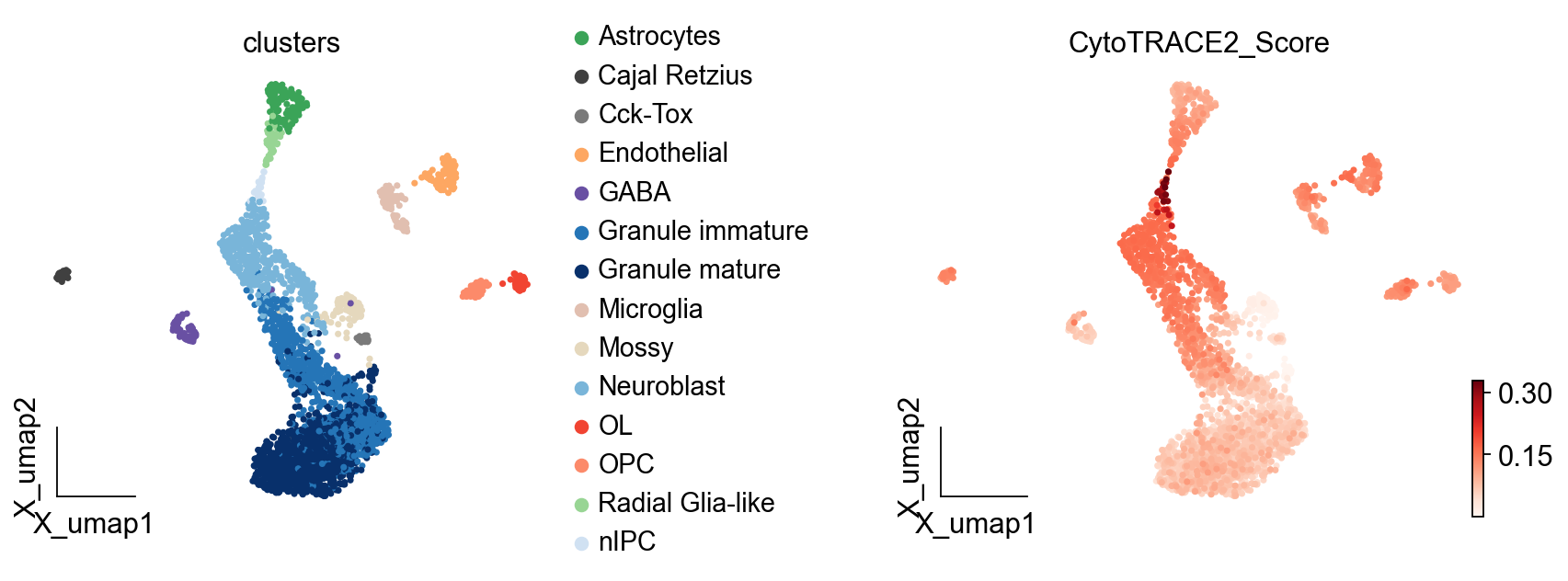
可视化CytoTRACE结果#
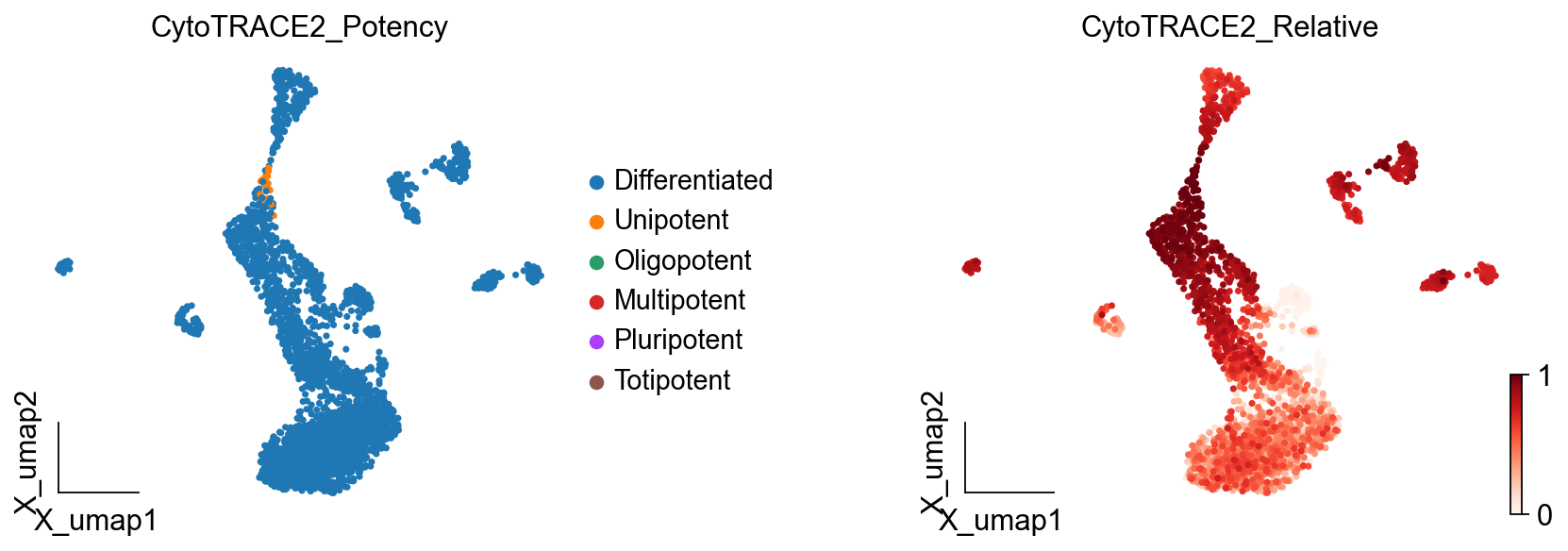
我们可以在多种降维方法中可视化CytoTRACE分数。
ov.utils.embedding(adata,basis='X_umap', color=['CytoTRACE2_Potency','CytoTRACE2_Relative'], frameon='small',cmap='Reds',wspace=0.55)
CytoTRACE在不同细胞类型中的应用#
CytoTRACE已成功应用于各种细胞类型和组织的分析。