
STFlow — per-slide flow-matching denoiser#
STFlow (Huang et al., ICML 2025 Spotlight) models the joint distribution of gene expression across an entire slide with a spatial transformer + flow-matching denoiser. The training set is the user’s own paired Visium reference; the trained denoiser then runs reverse-time ODE integration on the query tiles’ features + coordinates to sample cohesive whole-slide expression patterns.
Upstream ships training scripts only — there is no released zero-shot checkpoint. (The same group’s productionised successor, STPath, is the zero-shot path; see the STPath tutorial.) This wrapper therefore runs the canonical fit-on-your-reference, predict-on-your-query workflow on a single GPU in 5–10 min.
When to pick STFlow over the alternatives
Goal |
Use |
|---|---|
Zero-shot prediction on H&E only |
|
Per-slide fine-tune with paired Visium reference, joint cross-spot modelling |
|
Per-slide fine-tune with paired Visium reference, fast linear baseline |
|
Sub-spot super-resolution on paired Visium+H&E |
|
Environment#
import warnings
warnings.filterwarnings('ignore')

import omicverse as ov
import lazyslide as zs
ov.utils.ov_plot_set()

print('omicverse', ov.__version__, '| lazyslide', zs.__version__)
🔬 Starting plot initialization...
🧬 Detecting GPU devices…
✅ NVIDIA CUDA GPUs detected: 1
    • [CUDA 0] NVIDIA H100 80GB HBM3
      Memory: 79.1 GB | Compute: 9.0

   ____            _     _    __
  / __ \____ ___  (_)___| |  / /__  _____________
 / / / / __ `__ \/ / ___/ | / / _ \/ ___/ ___/ _ \
/ /_/ / / / / / / / /__ | |/ /  __/ /  (__  )  __/
\____/_/ /_/ /_/_/\___/ |___/\___/_/  /____/\___/

🔖 Version: 2.2.1rc1   📚 Tutorials: https://omicverse.readthedocs.io/
✅ plot_set complete.

omicverse 2.2.1rc1 | lazyslide 0.9.2
How the WSI flows through LazySlide#
ov.space.histo wraps LazySlide
for tiling, FM embedding, and the WSIData container.
STFlow only adds the flow-matching denoiser on top:
omicverse call |
LazySlide / wsidata under the hood |
|---|---|
|
|
|
|
|
|
|
omicverse-specific: trains the STFlow denoiser on a tile-grid cut from the reference, runs reverse-time ODE on query tile features, writes |
Inputs STFlow expects#
Same shape as HEST-FM — STFlow trains on the reference slide and predicts on the query tiles:
reference— paired Visium AnnData with.X,.obsm['spatial'], anduns['spatial'][lib]['scalefactors']['spot_diameter_fullres'].wsi—wsidata.WSIDatawrapping the H&E. The query tiles are whatever you’ve added viaov.space.histo.tile(); the reference patches are cut out one-per-spot on the same WSI.FM features for both reference and query tiles, in
wsi.tables['{fm_backbone}_tiles']. STFlow accepts any backbone (768-d CTransPath, 1280-d Virchow2, 1536-d GigaPath / UNI2, …) — feature dimensionality is read from the table; only consistency between reference and query matters.
For your own data:
adata, wsi = ov.space.histo.read_visium_with_image(
    visium_path='/path/to/spaceranger/outs',
    image_path='/path/to/HE.tif',
)
Model weights & cache layout#
STFlow has no released pretrained checkpoint (the authors productionised that path as STPath). It is trained from scratch on the user’s paired reference slide every run. The only thing downloaded is the patch encoder.
What |
From |
To |
Size |
Gated? |
|---|---|---|---|---|
|
LazySlide model registry → HF |
|
~100 MB |
no |
STFlow python package |
git clone |
|
~80 MB |
no |
reference / query tile features |
computed once |
|
~10–50 MB each |
— |
per-slide denoiser weights |
trained each run |
in-memory, not persisted |
— |
— |
$OV_HISTO_CACHE defaults to ~/.cache/omicverse/histo;
override with OV_HISTO_CACHE=/some/path (recommended on
HPC: point it at scratch). $HF_HOME defaults to
~/.cache/huggingface; override with HF_HOME=/some/path.
On first import omicverse also applies a tiny patch to
upstream stflow/model/transformer.py (the upstream
GeneUpdate.__init__ doesn’t accept a non_negative=
kwarg that the caller passes — a known upstream bug). This
keeps subsequent re-clones idempotent.
Swapping to a gated backbone — set
fm_backbone='uni2' / 'gigapath' / 'virchow2' once
you have HuggingFace access. Quality usually improves;
training time is unchanged.
Load the demo dataset and tile / embed#
This tutorial uses CTransPath (768-d, all-public) so it runs without HuggingFace gating. Swap in 'gigapath', 'uni2', or 'virchow2' for higher accuracy once you have access.
adata, wsi = ov.space.histo.load_breast()
adata
AnnData object with n_obs × n_vars = 3798 × 36601
    obs: 'in_tissue', 'array_row', 'array_col'
    var: 'gene_ids', 'feature_types', 'genome'
    uns: 'spatial', 'histo'
    obsm: 'spatial'
wsi

Reader: tiffslide
Dimensions: 24240×24240 (h×w), 1 Pyramid
Pixel physical size: 0.31 MPP
SpatialData object
└── Images
      └── 'wsi_thumbnail': DataArray[cyx] (3, 2000, 2000)
with coordinate systems:
    ▸ 'global', with elements:
        wsi_thumbnail (Images)
Tile the WSI and extract per-tile CTransPath features. Cached on disk under $OV_HISTO_CACHE/tile_features/ so re-runs return instantly.
ov.space.histo.tile(wsi, tile_px=224, mpp=0.5)
ov.space.histo.embed(wsi, model='ctranspath',
                     batch_size=16, num_workers=0)
print('tiles:', len(wsi.shapes['tiles']),
      '| feature table:', list(wsi.tables))
tiles: 1426 | feature table: ['ctranspath_tiles']
Train STFlow on the reference, predict on the query#
predict_expression(method='stflow', …) does the following:
on first use, auto-clones the upstream STFlow repo into
$OV_HISTO_CACHE/STFlow/and adds it tosys.path,picks
n_top_genesHVGs on the reference (or uses the panel you pass viagenes=),builds a small spatial-transformer denoiser, sized by
n_layers/hidden_dim/n_neighbors,trains it for
n_epochsiterations with AdamW on the reference (one forward pass = the whole slide; very cheap per epoch),runs
n_sample_stepsEuler integration steps of the reverse-time ODE on the query tiles to draw a sample from the conditional distributionp(expression | image, coords),wraps predictions as
wsi.tables['stflow_tiles'].
Key parameters#
reference— paired Visium AnnData (required).fm_backbone='ctranspath'— any registered pathology FM.genes=None— explicit panel; defaults to top-500 HVGs.n_epochs=80— training iterations. The paper trains for thousands of epochs over a multi-slide cohort; 80 is a practical demo budget that still gives meaningful predictions.n_layers=4— depth of the spatial transformer denoiser.n_neighbors=8— number of spatial neighbours each tile attends to.n_sample_steps=5— Euler steps for the reverse-time ODE (paper default).hidden_dim=256,batch_size=1— denoiser sizing.
Gene panel size is fixed at 50 — STFlow’s upstream
transformer (stflow/model/transformer.py:63) hardcodes a
+50 term in the attention-MLP input dim, so the panel
must be exactly 50 genes. Leave genes=None to use the
top-50 HVGs from the reference, or pass an explicit
50-gene list.
Pre-staging the patch-encoder weights#
STFlow has no released checkpoint of its own (it trains
per-slide); the only thing downloaded is the patch encoder
you choose via fm_backbone. To run air-gapped or with
a vetted local checkpoint:
pred = ov.space.histo.predict_expression(
    wsi, method='stflow', reference=adata,
    fm_backbone='ctranspath',
    fm_weight_path='/scratch/weights/ctranspath.pth',
    cache_dir='/scratch/omicverse_histo',
)
Compute — at the default settings the cell below takes roughly 5–10 min on an H100; most of the time is the ctranspath embed of the reference spot grid (cached for re-runs).
pred = ov.space.histo.predict_expression(
    wsi,
    method='stflow',
    reference=adata,
    fm_backbone='ctranspath',
    n_epochs=80,
    n_layers=4,
    n_neighbors=8,
    n_sample_steps=5,
)
pred
AnnData object with n_obs × n_vars = 1426 × 50
    obs: 'tile_id', 'library_id'
    var: 'gene_ids', 'feature_types', 'genome'
    uns: 'histo'
    obsm: 'spatial'
Reading the output#
pred is an AnnData whose rows are query tiles and whose
columns are the predicted gene panel:
pred.X(n_tiles × n_genes) — log1p predicted expressionpred.var_names— gene symbols (the 500-HVG panel by default, or whatever you passed ingenes=)pred.obsm['spatial']— tile pixel centroidspred.uns['histo']— run metadata (method,fm_backbone,n_epochs,n_layers,n_sample_steps).
print('shape       :', pred.shape)
print('first 5 vars:', list(pred.var_names[:5]))
print('coords range:', pred.obsm['spatial'].min(0), '→',
                       pred.obsm['spatial'].max(0))
print('metadata    :', pred.uns['histo'])
shape       : (1426, 50)
first 5 vars: ['ACKR1', 'CFHR1', 'IGKC', 'ANKRD44-IT1', 'ADAMTS9-AS2']
coords range: [4468.5 4355.5] → [22223.5 23521.5]
metadata    : {'method': 'stflow', 'fm_backbone': 'ctranspath', 'n_epochs': 80, 'n_layers': 4, 'n_sample_steps': 5}
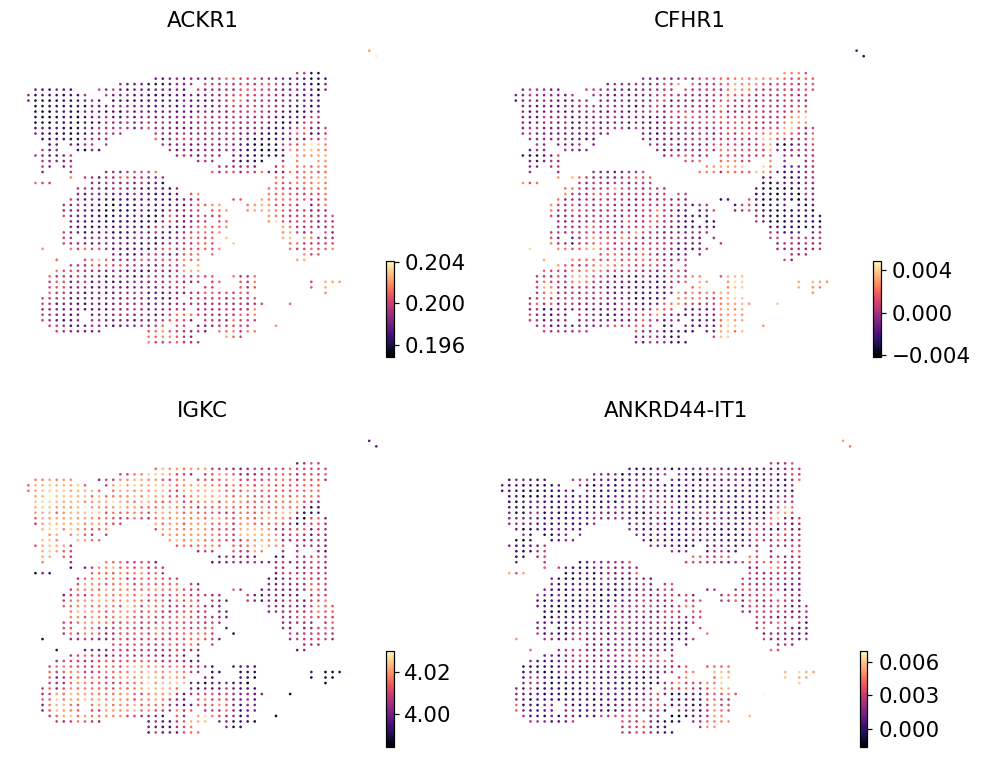
Visualise#
ov.pl.embedding(pred, basis='spatial',
                color=list(pred.var_names[:4]),
                cmap='magma', s=12, ncols=2, frameon=False)
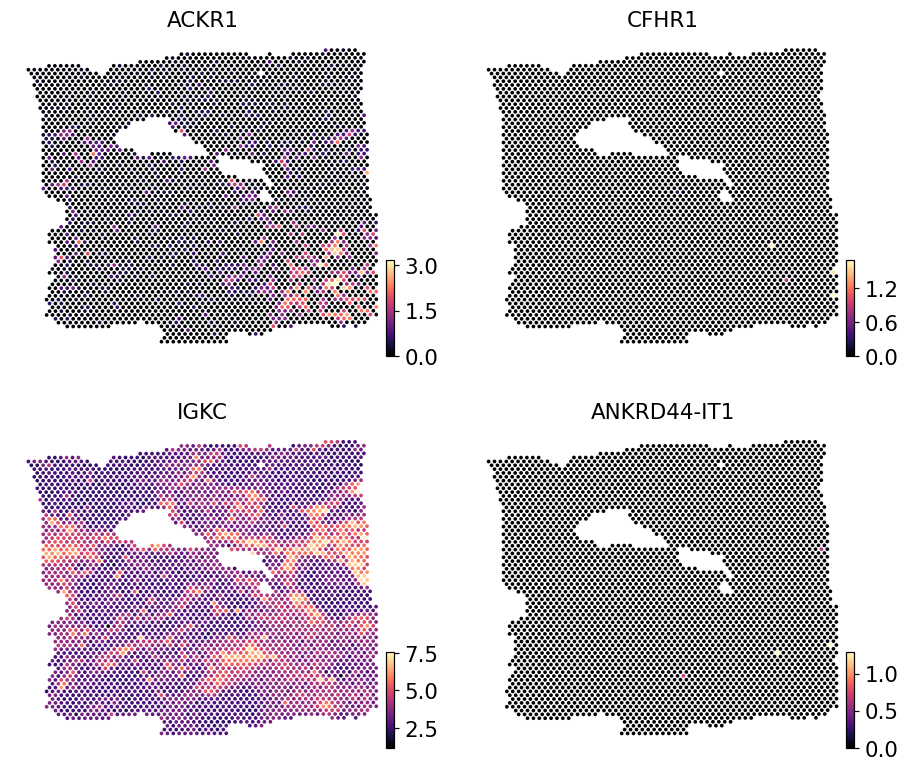
Real Visium counts for the same genes#
Plot the same four predicted genes from the paired Visium reference. The reference is log1p-normalised so the colour scale lines up with the STFlow output.
ref = adata.copy()
ov.pp.normalize_total(ref, target_sum=1e4)
ov.pp.log1p(ref)
ov.pl.embedding(ref, basis='spatial',
                color=list(pred.var_names[:4]),
                cmap='magma', s=24, ncols=2, frameon=False)
🔍 Count Normalization:
   Target sum: 10000.0
   Exclude highly expressed: False

✅ Count Normalization Completed Successfully!
   ✓ Processed: 3,798 cells × 36,601 genes
   ✓ Runtime: 0.05s
Per-gene scatter on Section 1 (training fit quality)#
The Denoiser was trained on Section 1’s spots, so this scatter is the best-case fit. Match each Visium spot to its nearest predicted tile and scatter the real log1p expression against the prediction. Pearson r in the title.
import numpy as np, matplotlib.pyplot as plt
from scipy.spatial import cKDTree
from scipy.stats import pearsonr

spot_xy = adata.obsm['spatial']
tile_xy = pred.obsm['spatial']
nn = cKDTree(tile_xy).query(spot_xy, k=1)[1]

picks = list(pred.var_names[:5])
ref_X = adata[:, picks].X
ref_X = np.log1p(ref_X.toarray() if hasattr(ref_X, 'toarray') else ref_X)
pred_X = pred[:, picks].X[nn]

fig, axes = plt.subplots(1, len(picks), figsize=(3 * len(picks), 3))
for ax, g, i in zip(axes, picks, range(len(picks))):
    ax.scatter(ref_X[:, i], pred_X[:, i], s=4, alpha=0.4)
    r, _ = pearsonr(ref_X[:, i], pred_X[:, i])
    lo = float(min(ref_X[:, i].min(), pred_X[:, i].min()))
    hi = float(max(ref_X[:, i].max(), pred_X[:, i].max()))
    ax.plot([lo, hi], [lo, hi], 'k--', lw=0.8, alpha=0.5)
    ax.set_title(f'{g}: r={r:.2f}')
    ax.set_xlabel('Section 1 real log1p')
    ax.set_ylabel('STFlow prediction')
plt.tight_layout()

Held-out evaluation on a fresh slide (Section 2)#
The STFlow Denoiser above was trained on Section 1’s spots and predicts on Section 1’s tiles — its training and query domains overlap, which inflates apparent quality. To get an honest read, predict on Section 2: the adjacent physical section of the same patient block (separate Visium dataset from 10x). Same anatomy and staining batch, but every H&E pixel is new to the trained head.
load_breast(section=2) downloads it on first use
(~1.7 GB cached). Note: STFlow’s per-slide head has to be
re-trained for the new slide, because the architecture
references each slide’s local spot graph during training —
we just keep using the same predict_expression(method= 'stflow', reference=adata, ...) call but point wsi= at
Section 2 and reference= at Section 1’s spots that we
still want to learn from.
adata_s2, wsi_s2 = ov.space.histo.load_breast(section=2)
ov.space.histo.tile(wsi_s2, tile_px=224, mpp=0.5)
ov.space.histo.embed(wsi_s2, model='ctranspath',
                     batch_size=16, num_workers=0)
pred_s2 = ov.space.histo.predict_expression(
    wsi_s2,                       # query: Section 2 H&E tiles
    method='stflow',
    reference=adata,              # train: Section 1 Visium spots
    fm_backbone='ctranspath',
    n_epochs=80, n_layers=4, n_sample_steps=5,
)
pred_s2
AnnData object with n_obs × n_vars = 1857 × 50
    obs: 'tile_id', 'library_id'
    var: 'gene_ids', 'feature_types', 'genome'
    uns: 'histo'
    obsm: 'spatial'
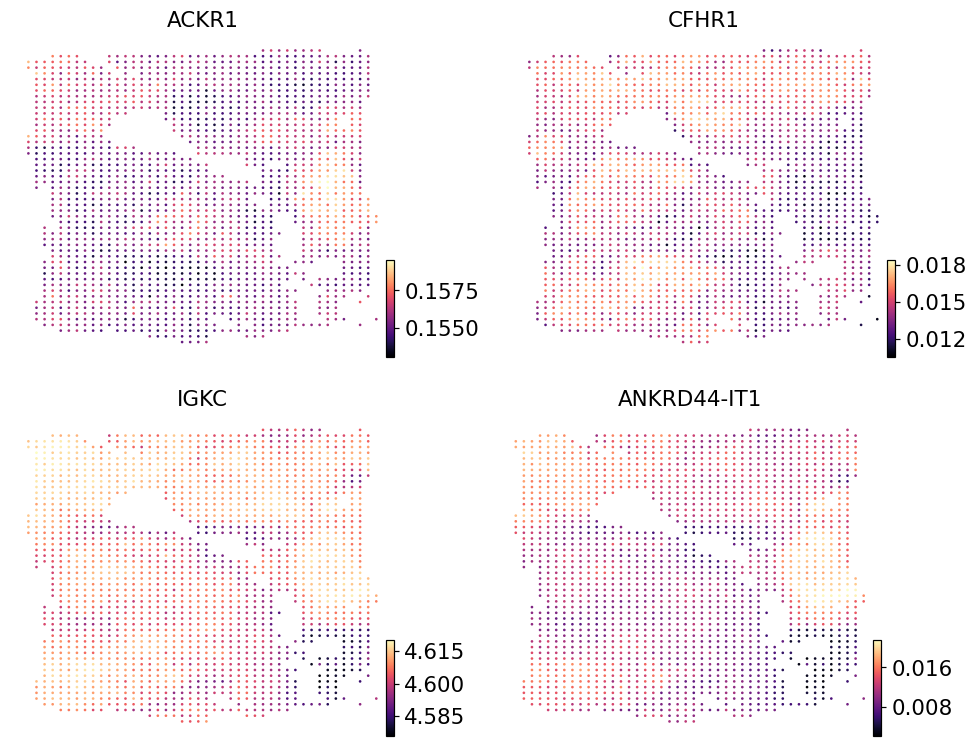
Spatial visualisation on Section 2 — prediction#
Same plotter as Section 1, pointed at the held-out slide’s predicted AnnData.
ov.pl.embedding(pred_s2, basis='spatial',
                color=list(pred_s2.var_names[:4]),
                cmap='magma', s=12, ncols=2, frameon=False)
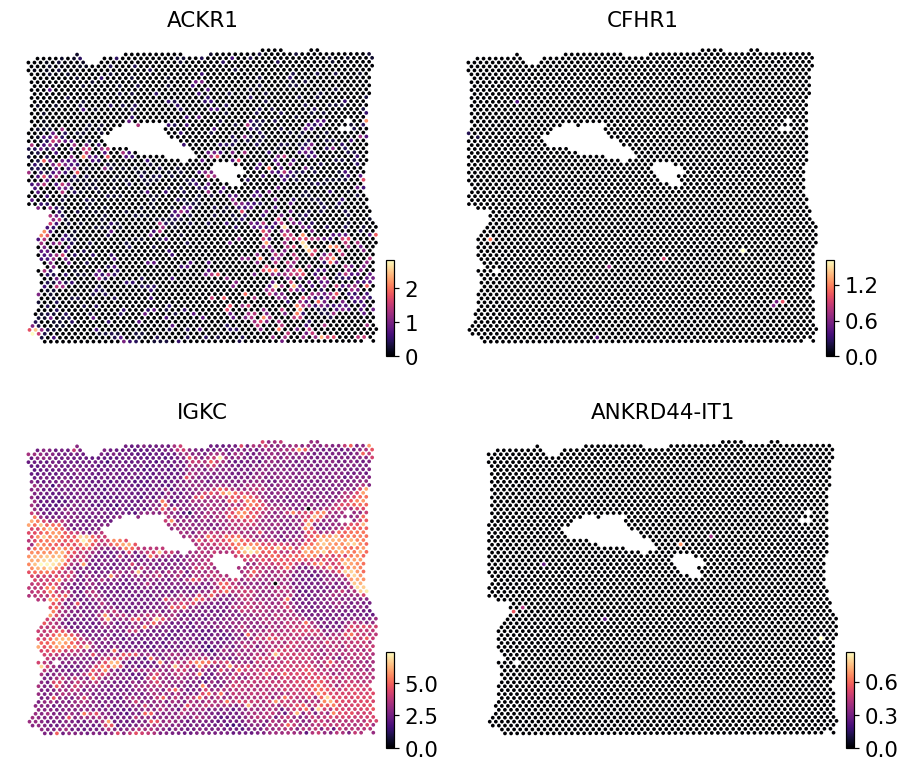
Spatial visualisation on Section 2 — real Visium counts#
Section 2’s real Visium expression for the same panel, log1p-normalised.
ref_s2 = adata_s2.copy()
ov.pp.normalize_total(ref_s2, target_sum=1e4)
ov.pp.log1p(ref_s2)
ov.pl.embedding(ref_s2, basis='spatial',
                color=list(pred_s2.var_names[:4]),
                cmap='magma', s=24, ncols=2, frameon=False)
🔍 Count Normalization:
   Target sum: 10000.0
   Exclude highly expressed: False

✅ Count Normalization Completed Successfully!
   ✓ Processed: 3,987 cells × 36,601 genes
   ✓ Runtime: 0.06s
Per-gene scatter on Section 2 (held-out)#
Match each Section 2 Visium spot to its nearest Section 2 predicted tile and scatter the real log1p expression against the prediction. Pearson r in the title.
import numpy as np, matplotlib.pyplot as plt
from scipy.spatial import cKDTree
from scipy.stats import pearsonr

spot_xy = adata_s2.obsm['spatial']
tile_xy = pred_s2.obsm['spatial']
nn = cKDTree(tile_xy).query(spot_xy, k=1)[1]

picks = list(pred_s2.var_names[:5])
ref_X = adata_s2[:, picks].X
ref_X = np.log1p(ref_X.toarray() if hasattr(ref_X, 'toarray') else ref_X)
pred_X = pred_s2[:, picks].X[nn]

fig, axes = plt.subplots(1, len(picks), figsize=(3 * len(picks), 3))
for ax, g, i in zip(axes, picks, range(len(picks))):
    ax.scatter(ref_X[:, i], pred_X[:, i], s=4, alpha=0.4)
    r, _ = pearsonr(ref_X[:, i], pred_X[:, i])
    lo = float(min(ref_X[:, i].min(), pred_X[:, i].min()))
    hi = float(max(ref_X[:, i].max(), pred_X[:, i].max()))
    ax.plot([lo, hi], [lo, hi], 'k--', lw=0.8, alpha=0.5)
    ax.set_title(f'{g}: r={r:.2f}')
    ax.set_xlabel('Section 2 real log1p')
    ax.set_ylabel('STFlow prediction')
plt.tight_layout()

Where to go next#
Just like the other HE-zoo backends, the predicted AnnData
slots straight into ov.space.pySTAGATE, ov.space.svg,
and friends. For a head-to-head on the same H&E, see
STPath,
HEST-FM, and
iStar.