
Transcription-factor motif activity with chromVAR#
Gene-activity scores (tutorial 2) tell you which genes are accessible. chromVAR (Schep et al., Nat. Methods 2017) asks a complementary question: which transcription factors are driving the accessibility differences between cells. For every TF motif it computes a per-cell deviation z-score — how much more (or less) accessible the peaks containing that motif are, relative to a GC/accessibility-matched background.
This tutorial runs the full chromVAR pipeline with ov.epi on the 10x PBMC-500 scATAC dataset:
preprocess fragments → tiles → clusters (the tutorial 1 flow, condensed)
call peaks per cluster with MACS3 (
ov.epi.single.macs3) and merge them (ov.epi.io.merge_peaks)build a cell × peak matrix (
ov.epi.pp.make_peak_matrix)annotate peaks with JASPAR motifs (
ov.epi.tl.add_motif_matrix)sample background peaks (
ov.epi.tl.add_background_peaks) and compute deviations (ov.epi.tl.compute_deviations)rank the most variable TFs and visualise their activity
Heads-up on runtime. Steps 4–5 download the GRCh38 FASTA (~1 GB, one-time) and scan ~900 JASPAR motifs over the peak set, which takes several minutes on CPU. Everything is cached, so re-runs are fast.
import warnings
warnings.filterwarnings('ignore')

import os
import numpy as np
import pandas as pd
import matplotlib.pyplot as plt

import omicverse as ov
ov.epi.pl.plot_set()
print('omicverse', ov.__version__)
└─ 🔬 Starting plot initialization...
  ├─ Apply Scanpy/matplotlib settings
  ├─ Custom font setup
  ├─ Suppress warnings
  ├─
___________      .__
\_   _____/_____ |__| ____   ____   ____
 |    __)_\____ \|  |/  _ \ /    \_/ __ \
 |        \  |_> >  (  <_> )   |  \  ___/
/_______  /   __/|__|\____/|___|  /\___  >
        \/|__|                  \/     \/

  ├─ 🔖 Version: 0.0.1rc1   📚 Tutorials: https://epione.readthedocs.io/
└─ ✅ plot_set complete.

omicverse 2.2.1rc1
1 · Preprocess (condensed)#
Same ingest → QC → tiles → iterative-LSI → clusters flow as tutorial 1, on the PBMC-500 fragments. chromVAR itself doesn’t need clusters, but we use them both to call peaks and to summarise TF activity per group.
genome = ov.epi.data.hg38
genes = ov.epi.io.get_gene_annotation(genome)

frag = ov.epi.datasets.atac_pbmc500_fragments()
work = os.path.join(os.getcwd(), 'data_epi')
os.makedirs(work, exist_ok=True)
h5 = os.path.join(work, 'pbmc500_chromvar.h5ad')
if os.path.exists(h5):
    os.remove(h5)

adata = ov.epi.pp.import_fragments(str(frag), chrom_sizes=genome, file=h5, min_num_fragments=500)
ov.epi.pp.tsse(adata, genes)
adata = ov.epi.pp.qc(adata, tresh={
    'fragment_counts_min': 1000, 'fragment_counts_max': 100000,
    'TSS_score_min': 2.0, 'TSS_score_max': 100.0, 'Nucleosome_singal_max': 4.0})
ov.epi.pp.add_tile_matrix(adata, bin_size=500)
ov.epi.pp.select_features(adata, n_features=250000)
ov.epi.tl.iterative_lsi(adata, n_components=20, iterations=2)
ov.epi.pp.neighbors(adata, use_rep='X_iterative_lsi')
ov.epi.tl.clusters(adata, method='leiden', use_rep='X_iterative_lsi', key_added='clusters')
ov.epi.tl.umap(adata)
print('cells:', adata.n_obs, '| clusters:', ov.epi.utils.obs_to_pandas(adata)['clusters'].nunique())
└─ scanning /tmp/snapatac2/atac_pbmc_500.tsv.gz
└─ imported 646 cells  (9,899,673 unique fragments)
└─ Computing TSS enrichment score for adata...
└─ Computing TSS enrichment score for adata...
└─ Added TSS enrichment score to adata.obs['tss_score']
└─ Created TSS enrichment score
  └─ Added TSS enrichment score to tss_pileup.obs['tss_score']
  └─ Returned TSS enrichment score
  └─ Added TSS enrichment score to adata.obs['tsse']
└─ Performing QC...
  └─ Filtering cells based on fragment counts...
  └─ Computing nucleosome signal...
└─ Computing nucleosome signal for adata...
└─ Added a "nucleosome_signal" column to the .obs slot of the AnnData object
└─ Created nucleosome signal
  └─ Added nucleosome signal to adata.obs['nucleosome_signal']
  └─ Added nucleosome signal to adata.obs['nucleosome_signal']
  └─ Filtering cells based on nucleosome signal...
  └─ Filtered 79 cells
└─ building tile matrix: 567 cells × 6,176,584 tiles (500 bp bins, strategy=paired-insertion)
└─ tile matrix nnz=9,638,878
└─ Selected 250,000 features.
└─ [iterative_lsi] Initial feature set: 500,000 / 6,176,584
  └─ [iterative_lsi] Iter 1/2 | fit on 567 cells x 500,000 features
computing neighbors
finished: added to `.uns['neighbors']`
    `.obsp['distances']`, distances for each pair of neighbors
    `.obsp['connectivities']`, weighted adjacency matrix (0:00:07)
running Leiden clustering
finished: found 6 clusters and added
    'leiden', the cluster labels (adata.obs, categorical) (0:00:00)
└─ [iterative_lsi]   -> 6 clusters; selected 25,000 variable features for next round
  └─ [iterative_lsi] Iter 2/2 | fit on 567 cells x 25,000 features
└─ [iterative_lsi] Done. Stored embedding (567 x 19) in adata.obsm['X_iterative_lsi']
Computing neighbors with n_neighbors=15
Finished computing neighbors
    Added to .uns['neighbors']
    .obsp['distances'], distances for each pair of neighbors
    .obsp['connectivities'], weighted adjacency matrix
Running Leiden clustering with leidenalg...
    Finished: found 9 clusters
    Added 'clusters' to adata.obs (categorical)
Computing UMAP embedding...
Finished computing UMAP
    Added:
        'X_umap', UMAP coordinates (adata.obsm)
        'umap', UMAP parameters (adata.uns)
cells: 567 | clusters: 9
2 · Peak calling and a cell × peak matrix#
chromVAR works on peaks, not genome tiles. We call peaks per cluster with MACS3, merge them into a single non-overlapping ArchR-style peak set, and count fragments per cell per peak.
peaks = ov.epi.single.macs3(adata, groupby='clusters', qvalue=0.1, inplace=False)
if peaks is None:
    peaks = adata.uns['macs3']
merged = ov.epi.io.merge_peaks(peaks, chrom_sizes=genome)
print('merged peak set:', merged.shape)

pk = ov.epi.pp.make_peak_matrix(adata, merged)
# carry the embedding/clusters over for plotting
obs = ov.epi.utils.obs_to_pandas(adata)
pk.obsm['X_umap'] = adata.obsm['X_umap']
pk.obs['clusters'] = obs.loc[list(pk.obs_names), 'clusters'].values
print('cell x peak matrix:', pk.shape)
└─ MACS3 peak calling: 9 group(s)
└─   calling peaks for '0' (117 cells)
└─   calling peaks for '1' (101 cells)
└─   calling peaks for '2' (79 cells)
└─   calling peaks for '3' (76 cells)
└─   calling peaks for '4' (72 cells)
└─   calling peaks for '5' (56 cells)
└─   calling peaks for '6' (43 cells)
└─   calling peaks for '7' (13 cells)
└─   calling peaks for '8' (10 cells)
└─ merged 108,585 non-overlapping peaks
merged peak set: (108585, 5)
└─ building peak matrix: 567 cells × 108,585 peaks
└─ peak matrix nnz=4,231,352
cell x peak matrix: (567, 108585)
3 · Motif annotation#
ov.epi.tl.add_motif_matrix scans each peak for JASPAR motif matches (default JASPAR2024 CORE
vertebrates) using the genome FASTA, producing a binary peak × motif matrix in
pk.varm['motif'].
fasta = genome.fasta() if callable(getattr(genome, 'fasta', None)) else genome.fasta
ov.epi.tl.add_motif_matrix(pk, genome_fasta=str(fasta))
print('peak x motif matrix:', pk.varm['motif'].shape)
print('n motifs:', len(pk.uns['motif_names']))
└─ [motif_matrix] reading sequences from /tmp/snapatac2/gencode_v41_GRCh38.fa.gz.decomp
└─ [motif_matrix] fetching motifs: JASPAR2024/CORE/('vertebrates',)
└─ [motif_matrix] 879 motifs | pvalue=5e-05
└─ [motif_matrix] 8,188,866 (peak, motif) hits | median per motif: 7,054
peak x motif matrix: (108585, 879)
n motifs: 879
4 · Background peaks and per-cell deviations#
chromVAR corrects for GC content and overall accessibility by comparing each motif’s peaks to a
matched set of background peaks. add_background_peaks samples them (using the FASTA for GC),
then compute_deviations returns the per-cell z-scores in pk.obsm['motif_deviations'].
ov.epi.tl.add_background_peaks(pk, n_iterations=25, genome_fasta=str(fasta), seed=1)
ov.epi.tl.compute_deviations(pk, motif_key='motif', bg_key='bg_peaks', method='analytical')

Z = np.asarray(pk.obsm['motif_deviations'])
tf_names = np.asarray(pk.uns['motif_deviations_names'])
print('deviation z-scores:', Z.shape, '| TFs:', len(tf_names))
└─ [bg_peaks] computing GC bias
└─ [bg_peaks] built 108,585 peaks × 25 bg peers
└─ [deviations] cells=567 | peaks=108,585 | motifs=879 | bg_iter=25 | method=analytical
└─ [deviations] densifying X.T (0.25 GB, C-contig)
└─ [deviations] observed deviation (M @ X_dense)
└─ [deviations] analytical null | fused peer-stats (numba prange, local buf)
└─ [deviations] analytical null | M @ (μ, σ²) fused sgemm
└─ [deviations] done. obsm['motif_deviations'] = (567, 879) float32 Z-scores; [motif_deviations_raw] holds uncorrected deviations
deviation z-scores: (567, 879) | TFs: 879
5 · Most variable transcription factors#
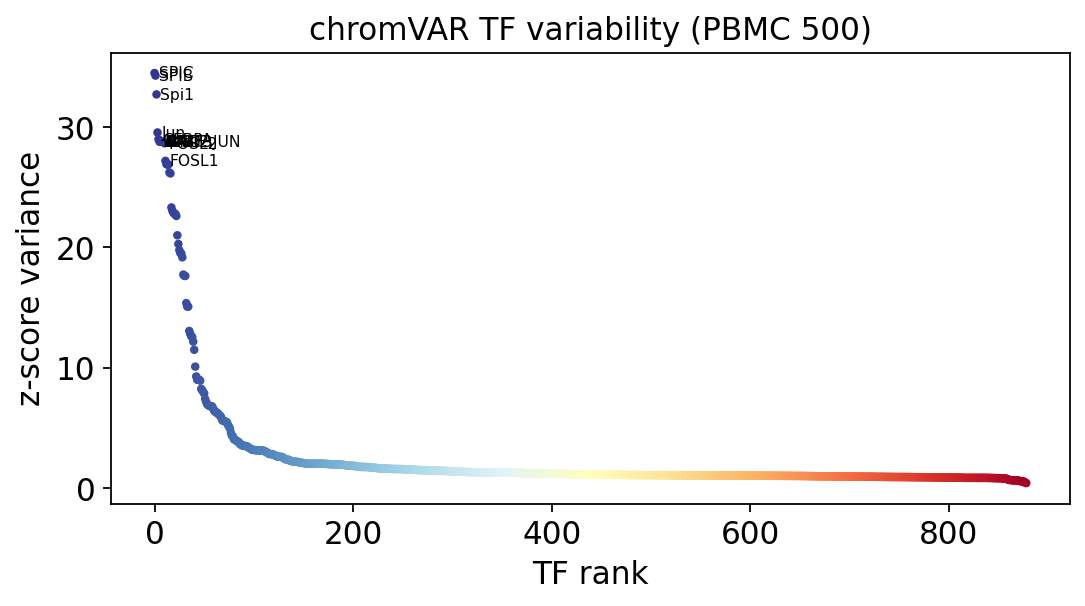
Ranking motifs by the variance of their z-score across cells surfaces the TFs whose activity varies most — the candidate drivers of cell-state differences.
variability = np.nanvar(Z, axis=0)
rank = np.argsort(-variability)

def tf_label(n):
    # JASPAR names look like 'MA0492.1_JUND' -> show the gene symbol.
    return str(n).split('_', 1)[-1]

fig, ax = plt.subplots(figsize=(7, 4))
x = np.arange(len(variability))
ax.scatter(x, variability[rank], s=8,
           c=plt.cm.RdYlBu_r(np.linspace(0, 1, len(x))))
for i in range(12):
    ax.text(x[i] + 4, variability[rank][i], tf_label(tf_names[rank[i]]),
            fontsize=7, va='center')
ax.set_xlabel('TF rank'); ax.set_ylabel('z-score variance')
ax.set_title('chromVAR TF variability (PBMC 500)')
plt.tight_layout(); plt.show()
TF activity on the UMAP#
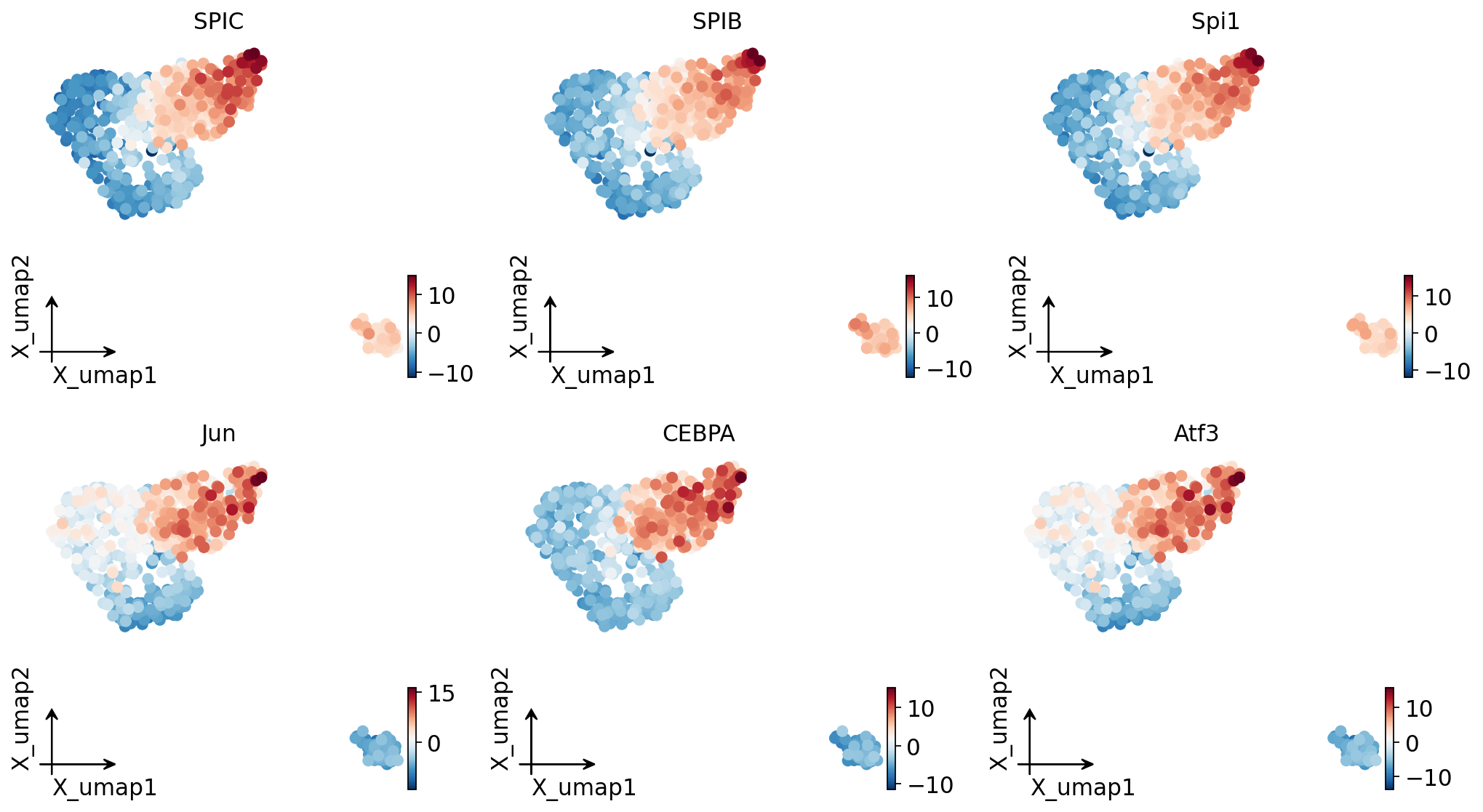
Colouring the UMAP by the deviation z-score of the top variable TFs shows their activity localising to specific cell populations.
# Stash the top variable TFs' deviation z-scores as obs columns and render
# them on the UMAP with omicverse's embedding plotter.
top = [int(i) for i in rank[:6]]
top_labels = []
for j in top:
    lab = tf_label(tf_names[j])
    pk.obs[lab] = Z[:, j]
    top_labels.append(lab)
ov.pl.embedding(pk, basis='X_umap', color=top_labels, frameon='small', ncols=3,
                cmap='RdBu_r', show=False)
plt.show()
Cluster × TF activity heatmap#
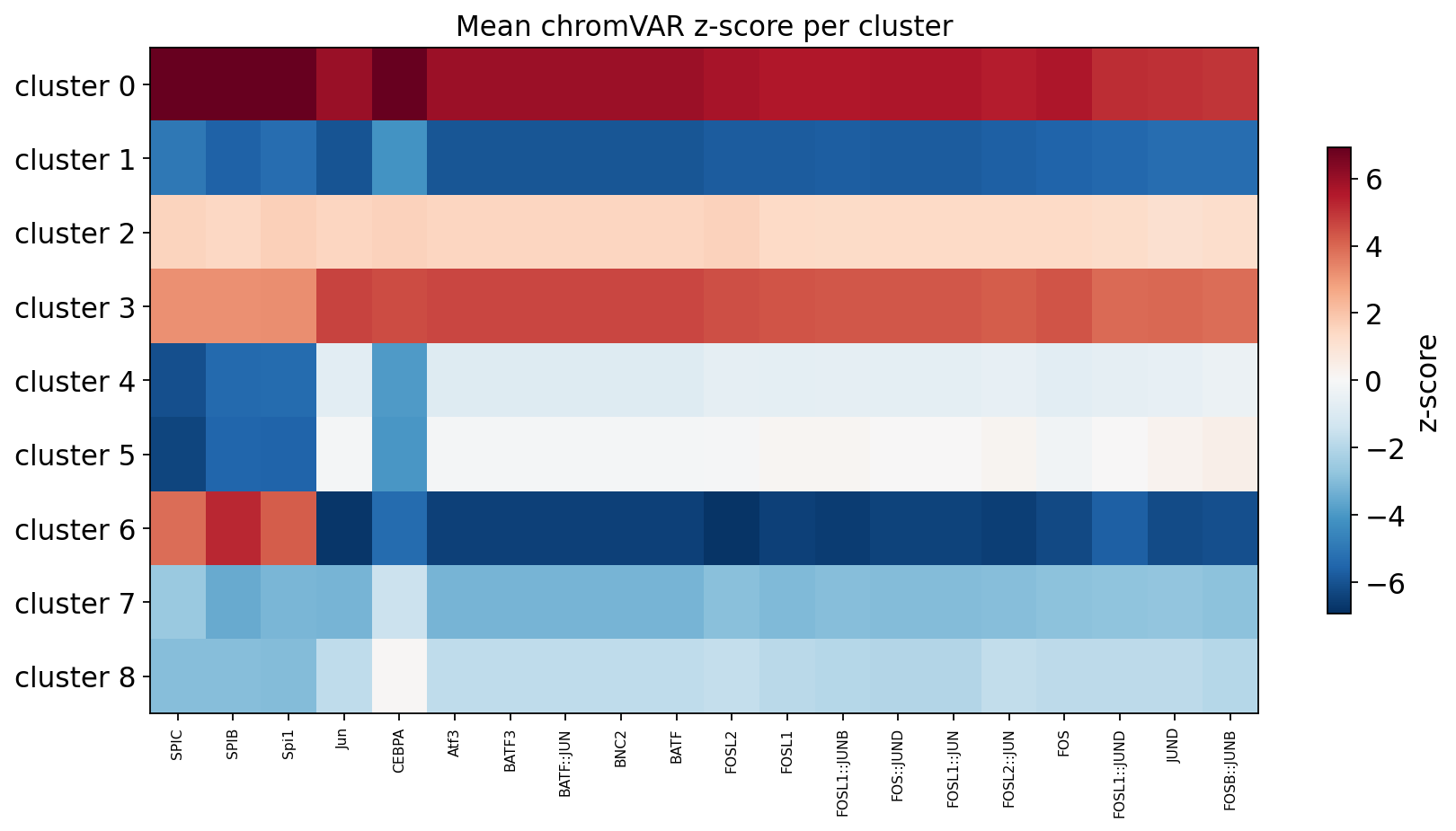
Mean deviation per (cluster, TF) for the top variable TFs — the chromVAR analogue of a marker heatmap, here in terms of transcription-factor motif activity.
top_n = 20
tf_idx = [int(i) for i in rank[:top_n]]
clu = pk.obs['clusters'].astype('category')
cats = list(clu.cat.categories)
heat = np.stack([np.nanmean(Z[clu.values == c][:, tf_idx], axis=0) for c in cats])

fig, ax = plt.subplots(figsize=(0.45 * top_n + 2, 0.5 * len(cats) + 1.5))
lim = np.nanpercentile(np.abs(heat), 98)
im = ax.imshow(heat, aspect='auto', cmap='RdBu_r', vmin=-lim, vmax=lim)
ax.set_xticks(range(top_n)); ax.set_xticklabels([tf_label(tf_names[j]) for j in tf_idx],
                                                rotation=90, fontsize=7)
ax.set_yticks(range(len(cats))); ax.set_yticklabels([f'cluster {c}' for c in cats])
ax.set_title('Mean chromVAR z-score per cluster')
plt.colorbar(im, ax=ax, label='z-score', shrink=0.7)
plt.tight_layout(); plt.show()
Summary#
stage |
function |
|---|---|
peaks per cluster |
|
merge peaks |
|
cell × peak matrix |
|
motif annotation |
|
background peaks |
|
deviations |
|
Together the three epigenetics tutorials cover the core single-cell ATAC workflow with ov.epi:
quality control, embedding and annotation, gene-activity scores, and transcription-factor motif
activity — the same pp / tl / pl grammar as the rest of OmicVerse, now over the
epione epigenomics backend.